
What’s your love language?
As you may know love is how humans function, and it’s applicability goes across industrial board. What does this mean? Well for starters in communication the big idea is to empathise with your audience, and what better way to do so than to speak to the elements that make the human tick like “LOVE”. People are complex – filled with certain preferences and different ways to communicate.

The marketing industry revolves around relationships. Marketers need to foster relationships between the brand they represent and their target audience in order to receive any success.
In the book, The 5 Love Languages: The Secret to Love that Lasts, author Dr. Gary Chapman states all humans express and receive love in different ways. A singing contest on Valentine’s Day, for example, may win the heart of one while embarrassing another. Similarly, takeaway by candlelight may be romantic to some and cheap to others.
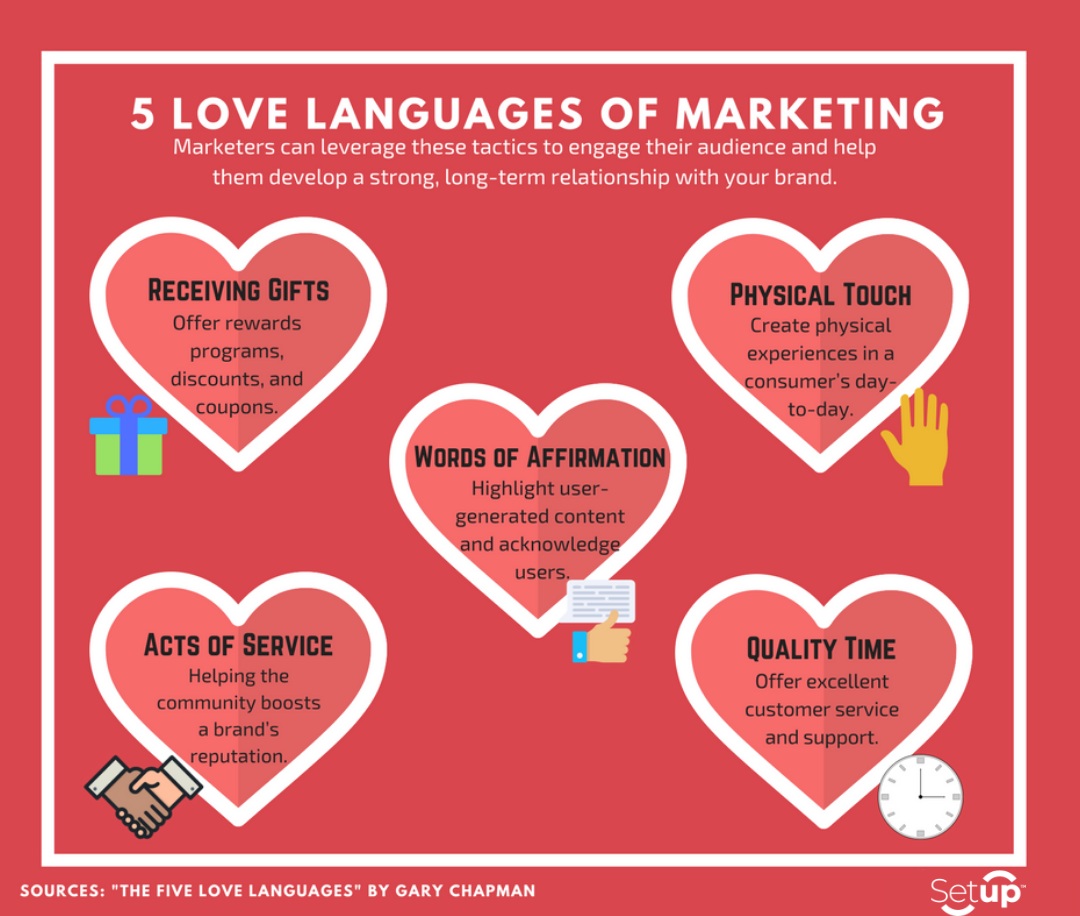
How you think or feel about these gestures stamps your love language. According to Dr. Chapman there are five: quality time, words of affirmation, gift-giving, acts of service, and physical touch.
Marketing, advertising, and communication all have love languages too.
Love Lingo: Words of Affirmation.
Create content that reflects consumer preferences and choices. In psychology speak, “mirror and validate.” Love, in the form of engagement, will be your reward.
This love language expresses love with words that build up your audience. Verbal compliments don’t have to be complicated; the shortest and simplest praises can be the most effective.
“That dress looks incredible on you!”
“ You are powerful”
Words mean a lot if your audience is receptive to this love language. Compliments can go a long way. On the other hand, negative or insulting comments can hurt your audience and it could take them longer to forgive than others.
Social media posts like weekly motivational GIFs and memes can be a great way to affirm your audience. They’re relatable and tongue-in-cheek, and they inspire.
Affirm your consumers for choosing the brand and engaging with the brand’s content by highlighting user-generated content and acknowledging them. Use data to get to know their personas to inform marketing campaigns and re-targeting personalized ads. Brands that have an uplifting message that inspires the consumer to achieve goals they could only imagine do well and create a loyal following. Like Nike, and their “Just Do It” slogan. Their product makes the ordinary consumer feel like they can accomplish the extraordinary.
Love Lingo: Quality Time
This love language means giving time to your audience. In content marketing, it means not taking time from a reader. Don’t waste your readers’ most precious commodity with wordy sentences and confusing jargon. Stick to the point of your product or sales pitch, get to that point quickly, and remind your reader that you value his and her time. Your reader will love and appreciate you for it.
Quality time translates to marketing through quality customer support. Take the time to offer excellent customer service by engaging with the target audience’s questions or concerns via social channels. This strengthens the relationship between the brand and the customer. The more energy a brand puts into “quality time”, the more brand loyalty is returned. Therefore, it’s important to listen, follow-up, and take the time to solve issues about product quality and complaints!
Love Lingo: Acts of Service
Acts of service are about benefit. Their benefit, however, is to both the individual and the group. (In love, the “group” is the relationship; in marketing, it’s society.) For example, a consumer who buys only organic bananas likely does so to benefit both his/her health and the environment.
If your product performs acts of service that benefit individuals and society/the environment/humanity at large, you’d be wise to highlight those acts of service in your marketing copy.
Love Lingo: Physical Touch
This love language applies to content marketing by way of creating a physical experience in the consumer’s day-to-day. The gesture can be as small as having an advertisement on a bus or billboard to having experiential marketing events like social media competitions.
Does your marketing content engender engagement, encourage participation, or facilitate dialogue among and between prospective consumers? Ultimately, this love language corollary is about connection, and it’s something your copy must be cultivating all day, every day. If it doesn’t, even the most dedicated consumer will lose interest.
Love Lingo: Gift Giving
You need to realize the consumer for their loyalty by providing rewards programs, discounts, and coupons. These offerings give the customer a great deal, plus a reason to tell friends. They will also come back over time to develop a long-term relationship with the brand. Word of mouth and referrals are still the most powerful advertising tool in business.
Does your product enhance beauty, reduce pain, increase wealth? Whatever it does, the marketing content that supports it should highlight its benefits and frame those benefits as special and exclusive to both your product and your product’s consumer. Without these benefits, it’s not a gift at all.
To speak your consumers’ love language, contact The Grammar Queen today.
 The Grammar queen